Frank Fritz, long time co-star of American Pickers, just passed away yesterday, September 30th, 2024. I've been a fan of the show since I first saw it, shortly after it hit the air in 2010. Frank had a stroke in 2022, leaving him in a wheelchair, and just passed away at age 60. He's best known for about a decade of driving around the U.S. with Mike Wolfe, looking to pick antiques and collectibles, to resell. They picked "rusty gold" treasures from garages, barns, long fading outbuildings, and anywhere else cool stuff has been stored for years.
Since I live in the San Fernando Valley now, I picked the segment where Mike and Frank visited custom car legend the late George Barris, in his shop in North Hollywood, California. They got to sit in the original Batmobile, from the 1960's TV show. That's a big thing for young Boomers and old Gen Xers. In that episode, Frank and Mike got a tour of the shop that put out decades of customized cars for TV, movies, and private clients. They did pick up some collectibles, photos and similar things, from Barris, but this clip is just the first part of that show.
My dad was a guy who was always "wheelin' and dealin'" all kinds of things as I grew up, items bought from gun shows, garage sales, and flea markets. He taught me how to make a few bucks on the side when I was a kid. Many years later, I got into buying and flipping stuff from storage unit auctions, and tried to turn that into a business at one point. That never really got going full time, but I still enjoy looking for odd treasures in old junk, and may get back to it some day. So American Pickers was right up my alley, and I really enjoyed Mike and Frank's adventures, and learned a lot from the show. So it's sad to see "the bearded charmer," as Mike often called him, pass on from this life. RIP Frank.
I don't drink, so I pretty much party like the Minions when I hit a milestone.
If you've been into BMX sometimesince 1986, you know 43 is to BMX what "420" is to weed/marijuana/cannabis culture. Check the last post. So I'm totally stoked to hit 143,000 views on a personal blog. Thank you everyone who's read a post, or a bunch of them, over the nearly 7 years of this blog, and my other blogs before this one. I keep trying to write reasonably interesting stuff, and just keep plugging along. Thanks for checking my work out.
I've now written well over 2,500 total blog posts, and pulled in over 450,000 total page views since 2008. I don't have ads on my blogs, I do them because I love writing and have a bunch of ideas at any given time. Every post gets a few views, some really resonate, and get a bunch.
Check out my Patreon page, you can support my creative work for as little as $3.43 a month. There's a few posts open to check out, and other content, including two e-zines you can download, if you sign up and support me. Thanks again! Let me know any thoughts and ideas you have, good or bad, on Facebook or Twitter (@steveemig43). Onward!
Wealthion founder Adam Taggart interviews Nick Gerli from Reventure Consulting in January of 2023, about the state of U.S. real estate in 2023. I think Nick has, by far, the best overall grasp on U.S. real estate these days. I've been following his YouTube channel since last Spring, and he's been calling where things are going incredibly well that whole time.
If you follow my blog(s), you know I have a geeky interest in economics, and consider myself an amateur futurist. Since I was a little kid, I've been trying to predict where society would be in the future. The late futurists Alvin Toffler, and his wife Heidi, are the people I look up to the most, in that repect. I've written quite a bit about my idea of The Big Transition, which is basically an extension of the Toffler's Third Wave theory, extended into our current time period.
I have a new blog called Adaptive Reuse SoCal, about finding new uses for old, abandoned, and unused buildings, as well as the economy and commerical real estate in general. Check it out!
I'll go more into my Big Picture concept of where I believe society is in the next post. I began writing this post two days ago, and the original version is now a 1,000 word+ behemoth. I realized I needed to turn this into three or four posts, so here's the first. These are the main people I look at to get more detailed info on different aspects of the economy, to fill in the Big Picture concept I have. Check out any that seem interesting to you.
New meme. This is kind of a sarcastic middle finger to all the lawyers in society who help shady people make screwing Americans legal, or more legal. 1913 is when the Federal Reserve was created, who blessed us with high inflation, and then this current recession that's just getting going, to fight their inflation. Uh... yeah... thanks guys.
Here's the Our BMX edit with highlights of the BMX jumping event from one of the Anaheim Supercross events in January 2023.
First of all... exactly when did BMX six packs turn into mountain ranges? These jumps are HUGE. I remember working at a Supercross event in the early 1990's, and all the MX jumps, except the finish tabletop, were about 6 feet tall. Then I rode down to Sheep Hills a couple of days later, and KOD jump take off and landing were about 7 feet tall. I thought, "Holy crap, BMX jumps are taller than motocross doubles and triples now, that's nuts."
Now BMX rhythm sections are gigantic. Seriously, they're insane in size now. And then we see the crazy stuff they're pulling off now. This six minutes just blew my mind. Enjoy.
Though I lived in the P.O.W. House for two stretches in the early 1990's, I didn't have a video camera at the time,so I shot very little video there. So here's a bit of Dave Parrick's video footage of Keith Treanor in the backyard, then Dave Clymer on the spine ramp out front, about 1992-93.
Sometime around 1989, a group of BMX racers formed, rented a house, and dubbed themselves the Pros Of Westminster, or P.O.W.'s. It was the first serious BMX rider house, a four bedroom, two bath, single story place, on Iroquois Road in Westminster. There was a total of 22 riders that lived in the house, officially, over the course of about five years. There were also at least 200 or more traveling riders, from across the U.S. and around the world, that spent one or more nights there at some point. The best known members of the P.O.W. house were Dave Clymer, Chris Moeller, Alan Foster, Brian Foster, John Paul Rogers, Todd Lyons, and Jay Lonergan.
A few riders, Dave Clymer, in particular, were there for long stretches, years, and others were there for a few months,at a time. Riders were moving in and out over the life of the P.O.W. House. Generally there were two guys in each bedroom, usually on single matresses on the floor, sharing the bedrooms. It wasn't as freaky as it sounds, it was just a bunch of 20-something, hardcore BMX riders, living cheap during the long recession of the early 1990's. We had 8 to 12 paying roommates pretty much all the time, though often several were away traveling. Rent on the house then was around $900 a month, I think. With utilities, each guy paid from $90 to maybe $120 a month for rent and utilities. At the time, renting a room in a nice apartment, in a traditional California roommate situation, was $350 to $400 a month. A one bedroom apartment was $600 or so. With rent and bills right around $100 a month, we could spend a lot less time working, and a lot more time riding our bikes and traveling, which was our main priority then, other than beer and women.
For about $1,200 initial rent and deposit, the P.O.W. House's changing group of roommates provided a dirty, rowdy, fun, and CHEAP, but sort of decent, place ot live. It worked for that time period, and for our group of guys, a couple of women, and Bob the Dog. No one was trying to escape homelessness, but we had a cool, if usually dirty, self-directed, super low cost, housing solution for all the guys looking for a super cheap place ot live in Southern California. Another house, the H.B. House, took over a couple years later, for more young BMXers, in the mid and late 90's.
Just to be clear, to me a "flophouse" is a house or apartment with a lot of mostly unrelated people living there, with cheap rent being a priority. In my mind, it's not a drug den, though there may be people getting high. Those places are crackhouses, a completely different thing, in my mind. The P.O.W. House was a bunch of us living cheap so we could ride our bikes more, basically. Artists and musicians and many college students have been living cheap for generations, and it's normal among action sports people and punk rock musicians to crash on people's couches and floors while traveling. I'm not trying to diss the P.O.W. House, just use it as a personal example of living cheap, compared the the homeless world.
Now, I realize it's 30 years later, and everything, except pizza, oddly enough, have gone up in price. OK, $5 pizzas are now $6 at Little Caesar's or 7-11 with their bonus program. Anyhow, rent has gone up dramatically, and the whole internet age has happened since.
In addition, the population of chronically homeless people, here in the L.A. metro area, and in nearly all major cities, has exploded. One of the resources being used to house some of these homeless people is called "Tiny Homes." These small, 8 foot by 8 foot, prefab shelters are built in little groups, on obscure pieces of land, since land is so expensive in Southern California. The people in these little communities share bathrooms, showers, and get some food from the people who run the places. They get to keep their foodstamps, to help them eat other meals.
It gets people off the streets, and into semi-permanent places, under a roof. These are temporary housing, while homeless people work through programs to get permanent housing, Section 8 or something like it, paid for by a group of government resources, aka your taxi dollars.
So far, that makes sense to most people. Give people a small place to live temporarily, get them off the streets, and into programs for whatever issues they are dealing with. But as a homeless guy myself, and a blogger, I've learned there aren't really programs for people who want to actually earn a real living again. The housing people talked to all of us in my current area, for a while, about the options. My first option was to share a tiny home with a street friend, a raging (though very funny) drunk, occasional meth user, who was prone to violent outbursts. I declined. I asked a lot of questions, since I've stayed long times in shelters while I was back east. I know theft, daily backed up toilets, lots of drama, and occasional fights, are always issues when you put a bunch of fucked up people in close proximity to each other.
I also did a bit of research. Having spent a long time in various forms of homelessness, I know that homelessness is now an industry in certain aspects. There are people working at non-profit organizations, and some businesses, making their living from "the homeless problem." I have no issue with businesses making profits, that's a major point of business. But back east, I learned how many crony deals work between non-pofit organizations, taking in donations, grant money, and taxpayer money, and funneling it into their buddies' businesses. Old fashioned cronyism. Some organizations are legit, but there's a lot of shadiness as well.
So I began to wonder how much these "tiny homes" actually cost. It was hard to find good numbers at first. One article said the tiny homes cost $7,000 and up. Another source I saw a while back said they cost $17,000. For quite a while, I had no idea what these "tiny homes" cost.
The subject came up while chatting with someone on Facebook, and so I took another look. I found this report, which comes up at the top of Google now. According to this report, by an organization that has been digging through records for years, to bring obscure info like this to the public.
It turns out L.A.'s "tiny homes" for the homeless, cost from $32,712 per bed, to $60,047 per bed, for an average of $42,344 per bed, for the 224 beds in the "tiny homes communities, built, at the time of the report. The report also says the service providers who are running the camps get $55 a night, per bed, for the services they provide on a continuing basis.
OK, this is a SHITLOAD of money to house 224 of the estimated 30,000 to 40,000 homeless people in Los Angeles county these days. Yes, Pallet, the company making these tinyhomes, is doing well, really well, their business has increased 7,000% in a couple of years early in the pandemic. Again, I have no problem with businesses making a solid profit. The "tiny homes" idea makes sense as one way to work on the huge homelessness issue in major cities.
My point here is that a bunch of us young BMX riders, 30 years ago, figured out a way to house ourselves for about $100 a month, which would equal $218 today, per bed, per month, figuring in inflation. We lived in a flophouse, a BMX rider themed flop house. That was during the long, double dip recession, and era somewhat like today's, in that sense.
My point is, I'm pretty sure we can do better, here in California. We are close to 40 million people as a state. That includes many of the most innovative people in the country. I'm pretty sure a few businesses here could build what are bascially pre-fab tool sheds, with a power outlet, and some portable bathrooms and showers, for less than $84,000 each (tiny homes are made for two people). You can buy a 8' X 12" tool shed, which is 50% larger than the "tiny homes," for $3,700 at Home Depot (link below).
I'm pretty sure there are plenty of contractors who could safely wire tiny homes for a single power outlet, in a small community. There are companies, like this onein California, that make good portable restrooms and showers. There are also lots of other types of small housing options that could potentially work to house homeless people, like myself, at many different price points. YouTube "real estate whisperer" Kristina Smallhorn has a bunch of videos on these options. Here are a few:
These ideas don't included using empty houses, empty retail buildings, empty office properties, buying current motels out, renting apartments, houses, and any other possible options.
Way back in about 1997, before my struggle with homelessness began, I worked as a furniture mover. one day we were moving a dirty Dogloo, an igloo-shaped, molded plastic dog house. Joking around, I asked my co-worker, "Why don't they make these things for homeless people, call them Bumgloos?" We laughed, and kept working.
The idea stuck in my head, and at one point, while homeless, years later, I was thinking about writing a novel about a guy who starts making the Bumgloos, (8 foot diameter, four foot high walls, with a domed roof that fits over them- so several could be packed on a flatbed truck) and builds a community for the homeless. That also winds up housing some artists, and BMXers and skateboarders who want to live super cheap. They build a skate/bike park, art studios, a mini mart, a miniature golf course, a P.O. Box shop (homeless need mail) and Kinko's type office place (computer rental for homeless people). Those businesses help put some of the people to work, and help pay for the community, drawing in business from the local city people. That was the basic idea, not just housing, but work and fun as well. I never wrote the novel, but I thought it out pretty extensively, while homeless, and unable to find any job, when I was in North Carolina (2009-2012, 2017-2018).
Obviously, that idea is similar to the current tiny home communities, happening in many parts of the U.S.. What you might not believe is that even Andres Duany, a major urban designer, and proponent of the New Urbanism movement, has been paid big bucks to share somewhat similar ideas, with his clients.
Several years ago, he was hired for a sizeable sum to help re-design, and help kickstart Highpoint, North Carolina's business development and economic prospects. Highpoint is a former industrial city, a leader in the furniture industry, that got hit hard by factories closing down in the 1980's-2000's. One asset they had was the dying Oak Hollow mall, a now fairly typical "dead mall." Duany's team suggested, (are you ready?) turning the mall property into a business incubator, using lots of shipping containers to let entrepreneurs and artists build the containers into live/work spaces, as well as using the mall's indoor area for similar purposes. Duany understands, and says so in the long videos of those Highpoint meeetings, artist, small business people, and entrepreneurs all need the same thing: CHEAP places to live and work. Cheap live/work places help them get their ideas off the ground.
Build a place where these people can do that, and you'll attract a lot of people with new ideas, who can then bounce off each other's creativity while living in this incubator community. In my nomeclature, this is nurturing "Creative Scenes." The leaders of Highpoint did not see benefit in the "crazy" shipping conatiner ideas, and they didn't apply any of these ideas. But I believe Duany and team are right on track for what's needed in so many places around the U.S. now. These same ideas could be used to house the currently homeless, as well as other groups of people looking to live really cheap for a while.
So there it is, a whole bunch of potential ideas to help chip away at the homeless issue in L.A., and anywhere else. Sheare your ideas and thoughts on Facebook, if you want to weigh in.
To be fair, this little group is an outlier, one of the most influential creative scenes in human history. They were much more influential than most Creative Scenes. But that wasn't apparent in the beginning, which is the point. The Homebrew Club, including it's best known members Steve Wozniak and Steve Jobs, created personal computers. Wozniak and Jobs founded Apple Computers, now Apple, which brought us the Macintosh, iPods, and iPhones, among many other innovations. A small group of creative people, a "creative scene," can have all kinds of effects, and even change the course of human history.
They were geeks when that was something everyone did not want to be. But they found themselves fascinated by eletronics, and the emerging technology of computers. Here's an interview from about 2004, with six early members of the 1975 Homebrew Club, in Menlo Park, California, including Steve Wozniak. These six geeks from the 1970's, and the others from their scene, changed the lives of nearly every single on earth. For real. That's how major of an effect a small creative scene can potentially have.
What is a "Creative Scene?" My definition of a Creative Scene is a group of two or more people, focused on advancing in some creative endeavor. Two kids in the back of a 3rd grade class trying to draw better airplanes than each other is a Creative Scene. A group of artists at a small indie gallery is a Creative Scene. The kids and staff working on a high school yearbook is a creative scene. A band, no matter how good or bad, is a creative scene. The kids riding skateboards, BMX bikes, and yes, even scooters,* at a skatepark, is a creative scene. Two women making Aunt Agnes' gooseberry jelly and selling it online, is a creative scene. Travis Patrana and the Nitro Circus lunatics is a Creative Scene. Todd McFarlane and the original posse that started Image Comics were a creative scene. Three 9-year-old girls in the front yard making up dance moves, is a Creative Scene. Amanda Palmer and whomever she's hanging out with at this moment, is a Creative Scene. One time Old School BMX freestyler Chris Lashua and his Cirque Mechnic is a Creative Scene. A blog or YouTube channel's creator(s) and their followers, are a creative scene. CBGB's in the 1970's, and later, was a creative scene. The group of Montreal street performers that created Cirque du Soleil, was a Creative Scene. The people riding BMX and mountain bikes at Sheep Hills today, is a creative scene. Gary Vaynerchuk and the people at VaynerMedia is a creative scene. Tyler Perry's movie studio in Atlanta is a Creative Scene. Yuga Labs, a hanfdul of artistic, former punk and hip hop influenced skateboarders and BMXers from Miami, that created the Bored Ape Yacht Club NFT's, and the Otherside metaverse, is a Creative Scene. And yes, Steve Jobs and Steve Wozniak, in their garage, Woz's cubicle, and Steve's bedroom, in 1975, were a Creative Scene... on that birthed Apple. You get the idea.
We all have some idea what an art scene or a music scene is. They are not only the artists or the bands, but the local gallery owners, the patrons who buy pieces of work or go see shows, the local arts organizations that plan the First Friday Art Walk, the local bars and clubs where bands play, and all the people playing roles who support these people and the scenes. Those are the best known kind of Creative Scenes.
There are scenes within scenes. There are better and worse scenes. Most Creative Scenes don't have any major influence, except to help people become more creative, and learn skills, either creative, ogranizational, or business-wise. A healthy creative environment, let's say a thriving city's creative community, has dozens, maybe hundreds, of loosely interconnected scenes, with many types of people playing roles in multiple scenes, moving between scenes, and bouncing off of, and inspiring each other. This type or creative environment separates a city like Austin, Texas from say Detroit, Michigan. Both have creative scenes, Detroit has been huge force in music from Motown to rock n' roll to early electronic music. But it's been devastated economically, and continues ot struggle as a city. Austin is peaking as a Creative Scene city, and currently thriving financially as a major tech hub city, where economic and creative Detroit's heydays were decades ago. But the cheap cost of living and post apocalyptic scenes of Detroit may set the seeds for more great Creative Scenes in the future. Time will tell.
This theme, Creative Scenes, is something I've been learning about since the 1980's, as a BMX freestyler, and ever since, through many creative projects, jobs, and experiences. I even lived in an indie art gallery once, back in 2005-6. That's where my Sharpie Scribble Style art technique was born.
Right now, in late 2022, I believe we are on the cusp of some of the biggest changes in society in modern times, which will take place over several years. Creative Scenes is where I'm going to focus my energy for the forseeable future. I've got a lot to say on the subject, so it's time to get to work. Buckle up, it's gonna be a crazy ride.
*As an Old School BMX guy, I love to make fun of scooter riders. And then R Willy came along... Damn him.
I actually got threatened to get beaten half to death once unless I quit publishing this blog. The blog had about 30,000 page views then. I kept blogging, and I'm glad I did. Thanks to everyone who has checked out a post or two or ten. I've retired this blog twice, but it still gets checked out daily. Thanks to a big surge yesterday, it clocked 138,000 page views, of the 450,000 across all my blogs. Thank you.
Here's the new idea and blog I'm working on, check it out:
BMX, skate, art, and other action sports spots and locations.
Ken Park airing over the spine of Tony Hawk's mini ramp, in Fallbrook, CA, 1989. That's me sitting on the rail watching. I was Don Hoffman's assistant that day, and shot a little Super 8 footage of Ken for Barge at Will. Tony wasn't there, he was doing a demo somewhere. I was bummed, I wanted to meet him. Still haven't done that. But I had lunch with Frank Hawk, Tony's dad, and Don, sitting in the bed of Frank's truck, listening to them talk about the "old days" of skateboarding, which was the late 70's and early 80's, at that time. One of those cool days of being a video guy for Unreel, Vision Skateboard's video company.
Still from my footage of Mark Cernicky, aka "Cernicky of Death," also from Vision's Barge at Will video. Brea halfpipe, 1989. Mark Cenricky more recently. Neither of these are in the blog yet, but they are a couple of the spots I visited as a camera guy, back in the day.
Three years and 11 months ago, in mid May of 2018, around dusk, a group of men with baseball bats and assorted clubs went into a patch of woods in Winston-Salem, North Carolina. The were out there to surround my tent, and threaten to "kick the tent in and teach me a lesson I should have learned a long time ago." I was in the tent where I lived alone. I had no weapon, no phone, and no way to record what was happening. They knew that. My tent had been searched a few times, and a wall slashed open once.
The group, of at least 8-10 men, likely more, stomped around outside, hit nearby trees, and the walls of my tent with their clubs, and told me I needed to stop blogging. The blog that had pissed them off was this one. Steve Emig: The White Bear blog was about 10 1/2 months old, and had 26 to 28,000 pageviews at the time. Something like that. I had started the blog three weeks after moving into the tent, in June of 2017.
When they threatened to beat the shit out of me, my reply was, "Hoka hey, it's a good day to die. Go for it." The quote fro mCrazy Horse just popped into my head. Apparently the guys weren't used to people standing up to them. After all, this was how The South had been run for over 300 years. They wound up having a discussion for 15 minutes or so, trying to figure out what to do. One guy, in a really thick Southern accent, helpfully offered to break all of my fingers so I couldn't type anymore.
I sat in my large tent, all windows and flaps closed, listening to their conversation, and waiting to see how things would play out. There was a thunderstorm rolling in, and Carolina storms are the most intense I've ever experienced. Ultimately, the guys just wandered back to their cars, parked in nearby Bolton Park, I presume. I hunkered down through another thunderstorm in the tent, and kept on blogging, and drawing my #sharpiescribblestyle drawings for food money.
There are people in the United States, right now, going to great lengths these days to suppress the free speech of some writers, journalists, artists, film makers, You Tube channel producers, and all kinds of other creative people. There are thousands of individual creative people, and businesses that produce and promote creative work, fighting for all of our free speech rights every day. Me? I just keep drawing pictures, blogging, and trying to make people laugh on social media.
Thanks for checking out this blog, reading posts, sharing and buying my #sharpiescribblestyle artwork, and supporting me in general. You guys and gals rock!
OK, enough celebrating these two little milestones. Time to go create some more shit...
Jessie Armand's black and white doodle art was THE Sharpie art style in 2011-12. Here's a cool time lapse of him doing an office wall.
My first attempt at a marker mural on paper, was in 2002, in a tiny room I lived in Garden Grove. It completely sucked. But it got me started making huge collages, and trying to find a cool way to blend colors with Sharpies. "Real artists" know that Sharpies dry quick, and you can't blend colors. I didn't bother asking any real artists. In late 2005, while actually living in an indie art gallery, I discovered my Sharpie Scribble Style. I've been evolving and pushing it for the 16+ years since.
As crazy as it sounds, I never bothered to google "Sharpie art" until 2012, after I had been drawing kid's names in #sharpiescribblestyle, and doing drawings for my niece and nephew. That was also about the time I found three skateboard decks by our dumpster, and did "Grey Trash" alien drawings, then mounted them on the decks.
When I did finally look up Sharpie art, this video, and a couple others of Jessie's work, are what I found. His style blew my mind. I started doing some black and white doodle drawings now and then to try and mimic his style, which I never came close to doing. My Sharpie doodles are pretty cool looking now, but not near as cool as Jessie's work from a decade ago. Check out this Lamborghini he did. Here's Jessie's website today. Wow.
Meanwhile, I kept drawing, and in late 2015, started drawing people, and trying to sell my drawings, since I couldn't make any money or find a "real" job. I'm still broke, but I've sold about 100 originals since. Here's one of my favorites...
The late, great, Stevie Ray Vaughn. #sharpiescribblestyle.
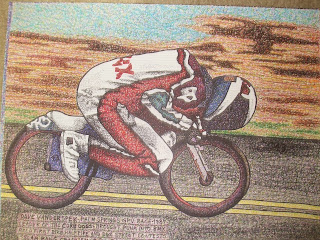
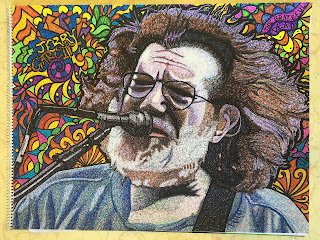
These are all 18" X 24" drawings, that took 35 to 45 hours each to draw, done in the Sharpie Scribble Style technique I invented. Above, Dave Vanderspek, full speed ahead, at the 1987 Palm Springs Tramway road GPV race, from the best photo I ever took. Below that,Vic Murphy's ultra classic 1 foot tabletop off a curb (from a black & white photo). Then Kurt Cobain drawing, drawn for my first little art show at Earshot Music in Winston-Salem, NC, 2017. Below that, Gene Simmons/KISS drawing at the same show. I drew the "KISS" in my tent in the woods, didn't have a reference of their logo, and yes, I know I did the S's wrong. It sold anyhow. Below that, Tupac Shakur. Then Jerry Garcia. #sharpiescribblestyle
Starting from above, Lana Del Rey, done for the 16th birthday of a girl named Erin, whose mother interviewed me for the Winston-Salem paper, in 2017. Below, this is me standing on stage with the Maya Angelou drawing I did in 2018, at a 90th birthday party in Winston-Salem for Maya, a few years after her death, where she lived the last decades of her life. Dr. Maya Angelou's niece and archivist, Ms. Johnson, has a full sized print of this in her collection. Yoda, done for myself in 2016, and now living on a wall east of Chicago. The Princess Leia drawing is one I started a couple days before Carrie Fisher got sick, and went to the hospital. By some freaky coincidence, I was drawing this when she passed away. RIP Carrie Fisher (she's getting a star on the Hollywood Walk of Fame this summer, BTW... finally). This is the second Johnny Cash drawing I did, and one of the earliest musician drawings. It was in the small art show I did at Earshot Music in Winston-Salem, in November of 2017. Bob Marley/One Love, done in 2017. The Blues Brothers drawing is another one I did for the show at Earshot Music, in late 2017, it sold a couple days later. The Ron Wilkerson drawing was the first large (18" X 24") BMX drawings I did in 2016, when I was just beginning to sell the drawings of people. #sharpiescribblestyle, #steveemigart
Longtime hardcore BMXer, driving force behind FBM for over two decades, TV announcer, and all around cool human, Steve Crandall.
I think it was 1994 when I met Steve Crandall. At the time, I was roommates with Chris Moeller and Timmy Ball in Huntington Beach. Between Chris being one of the best known dirt jumpers, and owning S&M Bikes, pretty much everyone in BMX from other parts of the country and world called when traveling to California, asking to crash on our couches and floors. So it was normal for me to come downstairs for breakfast and have complete strangers sleeping in the living room. One morning I was pouring some cereal, and Chris was making tea, and he pointed to the couch, "Those are the FBM guys over in the corner."
I don't remember much else of that weekend, except we did a lot of riding, and little partying with those guys. From then on, I'd run into Crandall at events every once in a while. Then, many years later, when I wound up homeless in Richmond, Virginia in 2018, Crandall sent me a message out of the blue. "Meet me at Powers Bike Shop later, here's the address." He did what he could to help me out, along with Chad at Powers Bikes. I actually was trying to make some money and live there, but I couldn't get momentum. But there is a really cool BMX and art scene there. Got to know Steve better, and finally spent a day at the DIY World Championships event, one of the greatest days of BMX I've seen. Anyhow, watch/listen to this podcast.
Just watched the Punk in Drublic festival documentary on YouTube. Really cool if you're an old punker. I'm having trouble trying to embed it on the library computer, so you'll have to go find it if interested. Like most people who got into punk, I guess, I was always one of those kids who just didn't seem to fit in the world. Punk rock was a place where all the weird kids found a community of other weirdos. And that was a cool thing. Out of that intellectual and creative weirdness came the DIY movement. The world doesn't want to make the songs, magazines, records, videos, or events you want to see? Do It Yourself. So we did, each in our own ways. 40-45 years later, that spirit is still alive. Cool beans.
Here's a short New School how-to video on the BMX Half Cab. I didn't invent the Half Cab, but when I started down a new direction with my riding in 1987, Half Cabs soon became one of my favorite and strongest tricks. I was doing 7-10 foot Half Cabs in 1988-89, and nearly clicked lookback Half Cabs in 1989. For real. But Half Cabs weren't even considered a "real trick," back then. It was just some weird thing I did, since I rode with skaters all the time.
At the Oregon AFA Masters contest in the spring of 1987, a trick by NorCal rider Tim Tracy became the trick of the weekend. That trick was the Backyard, and it was the first scuffing trick that went viral in BMX flatland. Whiplashes were still new then, and the whole idea of rolling forward tricks was just beginning to change the course of the evolution of BMX freestyle.
People have always done tricks on bikes. But what we know as freestyle began around 1980, with Bob Haro's demos at BMX races. Flatland tricks then were things like rollback 360's, and front wheel 360's on flat ground. The idea of BMX trick riding began to grow, and Bob Morales, R.L. Osborn, Mike Buff and a handful more, showed us the early tricks. Front and back wheel hops. Hip whips. Rollback 540's and 720's. 360 bunnyhops or "floaters." Martin Aparijo, Woody Itson and others got into the mix. Along came boomerangs, flatland tailwhips, decades, Switzerland Squeakers, cherrypickers, sliders, backwards wheelies, lawnmowers, funky chickens, Pinky squeaks, balance tricks, among other tricks.
Across the U.S., and in a few other countries, early BMX freestyle converts started learning the basics from magazine photos, and then inventing their own variations and tricks. BMX freestyle began to grow, and with the AFA in 1984, Bob Morales turned it into a sport with flatland, wedge ramp, and quarterpipe contests. In those early contests, it wasn't unusual to see 50 different riders, from novices to pro, doing tricks we'd never seen before. Then some tricks, like boomerangs, decades, and cherrypickers became standards that nearly everyone did. For good or bad, I was always trying to invent new tricks, I didn't really want to do all the same tricks everyone else did. Some riders specialized in taking the most popular tricks, and really dialing them in to do a tight routine. Others, like Oleg Konings and Eddie Roman, for example, tried to do mostly completely original tricks and variations. Most riders did several standard tricks, with a couple original ones in 1984-85-86.
At the Austin, Texas AFA Masters in 1987, an amateur rider, Kevin Jones, from York Pennsylvania pulled up into a backyard in his run. He had completely dialed in the new scuff trick from a month before, and then he snapped up into a no handed version, we learned later he called it the locomotive. Kevin didn't only scuff no handed, he kicked off and began to glide. A big group of us in the crowd went fucking berserk, so much so, that all the judges turned around to see what we were yelling about. We pointed down to Kevin, on the floor. He had just changed the whole game of flatland freestyle, and somehow we all knew it.
Back home after the contest, I tried the backyard, and I could get about 4 or 5 scuffs after stepping into it. I knew that it would take me weeks to get that trick down to where I was average at it. The same was true of the whiplash, which I first saw done by Denny Howell in late 1986. The forward rolling tricks were about to take over flatland freestyle. And I just didn't want to learn them, to just be mediocre at them. The flatland world soon turned into a "Follow Kevin Jones and the York guys" sport. The stuff they were doing was really hard, and amazing. But I still wanted to break new ground, not just keep trying to learn their newest tricks.
Around that time, the GT team had a show in Huntington Beach, a couple blocks from my house. After watching a cool show, and getting super stoked to ride, Mike Sarrail and I showed some young kids a few basic tricks to work on. Eventually the GT guys packed up, the kids rode off, and Mike and I were just doing our flatland. I had been thinking to myself, "Flatland is turning into a forward rolling, scuff/glide sport. It's not "freestyle" so much anymore, it's becoming 'clone style.'" You have to learn a certain style of tricks to even be in the mix in competitions. I wanted to keep trying new stuff, even if it meant giving up on competitions. After winning one contest in Idaho in 1985, I'd been placing in the middle of the huge packs for 3 years or so. I decided to go a totally different direction with my riding. I'd start exploring what could be done with hop tricks. But not the stationary pogo hop tricks, those had been done. I decided to start working on what else could be done with hops on a bike. I did an endo, and went into a backwards wheelie (on the back peg), one of my favorite tricks at the time. In the middle of the wheelie, I tapped the brakes and did a small hop, and tried to land back into a backwards wheelie, and keep rolling. I'd never tried it before, and never seen anyone else try it either. After a couple of tries, I pulled it off. It wasn't very hard. It wasn't a big trick by any means. But that feeling of landing something completely new, that stoke, was there. I did a few more, and I started thinking about other types of hop tricks that might be possible. That was the summer of 1987.
One of my best tricks then was 180 bunnyhops... at speed. A couple days later I went to a basketball court in a park near my house. I started doing 180 bunnyhops, and then trying to bunnyhop while rolling backwards. My 180's were really low, and I took off of both wheels, rather than pulling the front end up up like a "real" bunnyhop. Doing them that way, I could do a bunnyhop 180 at nearly full sprint speed. I would land backwards, and sit down (high seat days), and backpedal to keep up with the freewheel. Usually I would do a 180 out, or "cool guy turnaround" as I called them, a Martin Aparijo trick where you turn the front wheel partly backwards and slide it around until you're going forwards. But that day at the basketball court, I started doing bunnyhops while rolling backwards. After and hour or so, I had them pretty dialed. I kept practicing backwards bunnyhops for a few days, and by then I was bunnyhopping 6-7 feet, maybe farther, backwards. That was pretty cool.
Every weekend in those days, if there wasn't a contest, I was riding at the Huntington Beach Pier. There were 3 or 4 of us regular bike freestylers, plus a few freestyle skaters. Pierre Andre', Don Brown, Hans Lingren, and H.B. local Jeremy Ramey, were the main ones. But since the HB Pier was a known spot, pretty much anyone could show up. Ed Templeton was a local street skater, and he came by often, as did Bob Schmelzer and Per Welinder. There was a whole crew of HB street skaters, and Mark Gonzales showed up now and then, too. On the bike side, guys like Martin Aparijo and Woody Itson rolled up once in a while to session, there was a crew from Lakewood that came by a lot, and anyone else, from Eddie Fiola to Josh White, might come by and ride flatland for the crowds for a while.
We had crowds every half an hour or so, usually with 100 to 200 people, gathered 'round. Sometimes up to 500 people would stop to watch. Normal people, even Californians, still stopped to watch BMX and skate freestylers back in those days, most people had never seen freestyle skating or BMX, since it was never on TV back then. Basically, we were street performers who never put a hat out. I once figured out that I rode in front of over 140,000 people during those weekends at the HB Pier, 100 to 200 people at a time. I spent as much time riding with skateboarders as I did riding with BMXers, in those years from 1987 to 1992 or so. My weekend riding was for crowds, so I added the high speed 180's and backwards bunnyhops into my trick bag. It wasn't long after that I started doing Half Cabs. For those not familiar, that's rolling backwards, and then doing a 180 bunnyhop back into riding forwards. The reason Half Cabs are upper case, is because "Cab" is a name, for the inventor, vert skater Steve Caballero. He invented a vert trick in the early 1980's called the Caballerial. He would roll backwards (aka fakie) up the transition, and pop off the wall and do a 360 Ollie (without using his hands). After spinning a full 360 on the vert wall, he would roll back down the wall forwards. This quickly became known as a Cab. When a skater did a fakie Ollie to 180, either on vert or on flat ground, then it was called a Half Cab. So after the straight backwards bunnyhops, I started hopping my 180's, which in skater lingo was a bike version of a Half Cab.
Since I rode a freewheel (I hated coaster brakes and freecoasters), my pedals would turn backwards when I was rolling backwards. I just had to backpedal a bit faster, which was not hard when I was sitting down. But freewheel gave me an edge doing flat ground Half Cabs. Because my pedals rolled backwards, I could put a lot of pressure on my outside pedal when I did Half Cabs, so I could really hop. And since I could do super fast 180 bunnyhops, I could roll backwards faster than pretty much anyone in freestyle back then. When I put those two together, I started getting a decent amount of distance on my Half Cab bunnyhops. I kept pushing those, and within a couple months, I was traveling 6-7-8 feet backwards, while turning around mid-air, in my Half Cabs. I've probably done 10 foot+ Half Cabs at times. Then, in 1989, the H.B. Pier bank opened up, when some skaters cut and "lost" the huge chain that had blocked it for years (it's supposedly buried in the sand, far out under the pier now). I started riding that bank almost every night. Before long I was jumping off the top of the bank (which was small and mellow) doing 180's. Then one night I did a little lookback attempt in a 180 flyout. I didn' get very high, so it wasn't very clicked, but it was fun. Since I landed those rolling backwards, I would Half Cab out of them. So I started trying a lookback in the 180 jump, then a lookback in the Half Cab turning back around. Those were really slow, and more of goofy "turnbars" than a lookback. But then I started trying lookbacks in my big, fast, long Half Cabs. And I could get them about 2/3 clicked. I was doing pretty decent lookback Half Cabs by the summer of 1989. To this day, I've still never seen anyone else do one.
As freestylers, we've all played games of FREESTYLE, like HORSE in basketball, where one rider does a trick, and then everyone has to pull it, or get a letter. When I was hanging out at the HB Pier, I would get into games of SKATE with skaters, usually street skaters. They'd do a skate trick, and I'd try to do the closest bike version of that trick. That was fun and got me thinking in totally different ways about what I could do on my bike. I had learned the original sidewalk crack nollies on a skateboard, and then took those to BMX, doing high speed nosewheelies into small curbs and speed bumps. launching low for a few feet off the front wheel. My BMX was getting more and more skate inspired, as I faded away from flatland.
One day at the pier I was playing a game of SKATE with some of the local street skaters, and one of them did a no comply. That was a real popular street trick at the time, and was a footplant ollie 180. So I did a footplant on my bike, and tried to boost into a 180, and land riding backwards. I don't think I got it first try, but I got pretty close. That turned into another skate inspired trick, and another hop trick as well. I got those dialed, and I think I was the first BMXer to do a flat ground footplant to 180, aka a skateboard no comply on a bike, back in 1989 or 1990. That's the one trick of mine that Eddie Roman put in the 1990 2-Hip video, Ride Like a Man. Eddie was doing footplants to 360's, and I had him trying one of those in my 1990 video, The Ultimate Weekend. When we sessioned for the shoot of him for my video, I showed him that I had been doing footplant 180's, and he had been doing them to 360, and neither of us thought of doing the other version.
The other big hop trick I was trying all through those years, is the bunnyhop tailwhip. I've written about that quite a bit in previous posts. I started trying those in the summer of 1987, and could come close in late 1989 and 1990. But I was never able to land a single one, and actually get both feet on the bike. You Old Schoolers know that Bill Nitschke, back in Indiana, invented bunnyhop tailwhips, aka the Whopper, in 1990. He was a much better rider than me, all around, and it took him a year to learn that trick.
My frustration with not being able to land bunnyhop tailwhips led to a couple of footplant versions of that trick. I did one that I called a no-comply tailwhip, where I would bunnyhop and begin to huck the back end of the bike around, and as I was doing that, I would jump off the back of the bike, plant both feet on the ground real quick, and then jump back on as the bike came around. Since that was just a dork trick, I could land those easy. They looked kind of cool, especially when I did them on banks. At the 1989 2-Hip Meet the Street at the Brooklyn Banks, I did a few of those on the small banks, and 3 or 4 other guys started trying them. I wasn't used to people trying tricks that I did, so that was pretty cool. I also learned to do a tailwhip footplant on the wall, at that contest. There was a section of wall a ways back, on the bigger banks, with a tiny, 1/2 inch wide ledge. It was just enough to help my foot get a little more grip on the wall, and help me stay on the wall a bit longer, and do a tailwhip footplant. I also used to do a straight footplant booster to tailwhip. That was probably the coolest trick to come out of my attempts at bunnyhop tailwhips. I'd ride along parallel to a ledge or bench, bunnyhop up and footplant with my right foot. Then I'd boost higher off that foot, throwing the bike around in a tailwhip at the same time. So the bike would be 3-4 feet off the ground. Then I 'd land on the top tube and pedal, like I would on the flat ground, no-comply taiwhips. Again, none of those things were considered "real tricks" back then. Nobody else, except Eddie Roman, was doing anything like a half Cab, or street tailwhip tricks.
Sometime in late 1989 or 1990, after doing big Half Cabs for a couple of years, I realized that I should try to keep going with the Cab idea. So I started trying full Cabs (rollback to 360 bunnyhop) one night, and then I tried doing them to 540 (rollback to 540 bunnyhop). I did land full Cabs on flat, in 1990, I think. I came close to the 540 Cabs, which I was going to call a King Cab, since I had a Datsun King Cab truck. I could kickstand them, sticking a leg out, but could never land a clean one. I also tried tailwhip Half Cabs, but could never even come close to those.
The last hop trick I tried back in 1989-90 was one I really wish I could had landed. As I wrote above, nollies on a bike became a favorite trick of mine. I loved hauling ass at a big speed bump, going into a nosewheelie a couple feet before it, and doing a nollie. In my opinion, it's not a nollie on a bike if you don't hit a bump with the front wheel. What most New School riders call "nollies" today are nose wheelies, in my opinion. They do amazing ones, nosewheelies to barspins off ledges, and nosewheelies to tailwhips, but they're not nollies, in my opinion. But that's the old salty guy in me.
So the other cool nollie trick that I actually tried for a while was a nollie tailwhip. I'd nosewheelie into a speed bump, pop off the front wheel, and huck the back end of the bike into a tailwhip. On flat ground, with just a speed bump, not off a ledge. The problem with learning that trick is that since I was only 2-4 inches off the ground, the back end of the bike would usually hit the ground about halfway around, then I'd land on my stomach, on top of the bike. That fucking hurt, every time. I did he bike more than halfway around at times, it was a brutal trick to try and learn, just landing on top of the bike, stomach down, getting poked by pedals, stem, pegs, and everything else, every time. So I just gave up on that one. But I know it is possible. After all, tailwhip Half Cabs, 360 tailwhip bunnyhops, and even a 720 bunnyhop have been done (really check YouTube). More is possible.
For those who knew me back then, you might be wondering why I didn't put any of these tricks in my 1990 video, The Ultimate Weekend. It's the same reason I didn't put any of our flatland riding at the pier in the video. I didn't think those tricks were really tricks. That stuff we did every weekend just seemed so "normal" to me, that I didn't even shoot video of it. I was trying to get the newer riding, which mostly street stuff. Plus, I thought I sucked at that point, so I didn't put much of my riding at all in the video. That's my biggest regret from The Ultimate Weekend, I didn't put any of our weekend sessions in, I never even shot video of that. Mike Sarrail was one of maybe the first) guy to do barspin and no handed Miami hop-hops, and undertakers, and Randy Lawrence could learn pretty much any trick in 10 minutes. But I didn't think that was worth shooting back then. I had a few unique flatland tricks as well, like no handed and barspin megaspins, and an opposite tailwhip-catch, to double tailwhip normal direction, and a few others. I never got any of those things on video, and that was stupid.
Obviously, I had no idea that 10-20 years later Half Cabs, bunnyhop tailwhips, and nollies would wind up being "cool" tricks. On one hand, those tricks I did 30 years ago that "weren't real tricks," that are now popular, is a cool bit of validation. I tried some weird stuff that wasn't cool BITD, but eventually, riding circled around and those tricks, like Half Cabs and nollies, found a home.
My other reason for writing this post is that at any point, there are one or two main styles of riding that are cool, but there are still different directions of riding waiting to be explored. In today's world of long frames, low seats, and freecoasters, a different bike set-up, with today's skill rider skill levels, would make all kinds of new types of new tricks and variations possible. Remember kids, it's called FREEstyle. you are free to completely ridiculous (and currently uncool) ideas, and see what happens. Just sayin'.
I have a new blog about BMX, skateboard, and action sports spots:
I just heard Betty White passed away today (December 31, 2021), within 3 weeks of her 100th birthday. While most people in my generation remember her from The Golden Girls, or maybe The Mary Tyler Moore Show when we were kids, I was totally a fan of Off Their Rockers. C'Mon... Betty White leading a geriatric crew to make the Jackass of old people, how can it get better than that? That show was epic. Seriously, gut laugh funny. RIP Betty White. Look out afterlife, shit's about to get a whole lot more entertaining there.
What's the best revenge for all those people who told you your whole life that everything you want to do is not possible? Make it happen, and then outlive the motherfuckers. Goodbye to one of the funniest ladies ever.
Rodney Mullen is probably an alien. He's too weird and cool and innovative to be from this planet. Skaters used to say he was a mutt of a human, and that's the title of his book.* He's one of the coolest, most genuine people I've ever met, an amazing skateboarder, an original member of the Bones Brigade, and a guy who has gone on stage to explain creativity and innovation to some of the smartest people in the world, at TED Talks. Here's a look at Rodney Mullen. Above is a brand new interview of Tony Hawk and Jason Ellis interviewing Rodney for their podcast Wolf vs. Hawk. I got about 50 minutes into this last night, it's a great podcast.I need to listen to the rest tonight.
"Just try to be an individual when you skate. Don't look at others, don't think about others, it just brings you down... It comes out of you, that's how it gets good."
-Rodney Mullen, in the mini interview I did with him when he was 19, at The Spot in Redondo Beach, in late 1986 for FREESTYLIN' magazine. Follow this link, and go to the December 1986 issue of FREESTYLIN', page 56, to check out that interview.
On my second night in Redondo Beach in 1986, my new co-worker and roommate, Mark "Lew" Lewman, led me down to the place where he and a few locals practiced flatland BMX freestyle every night. The large brick paved area, on the north end of the Redondo Beach Pier, had been dubbed The Spot by the freestylers. "There's a skater down there you have to meet," Lew yelled back, as I followed him on my Skway. "He's amazing."
On that night, I think it was just Lew and I practicing our flatland freestyle tricks. After an hour or so, a sandy haired guy on an old beach cruiser road up. Lew said "Hi," as the guy rode past and set up on the smooth concrete area, next to The Spot. In between trying my tricks, I watched this skater pull his socks up to his knees, and put on knee pads. Then he checked out his skateboard, meticulously put white tape on his finger tips, and then went through some stretching exercises. Only then, 15 minutes or so after arriving, did he step onto his small, flat freestyle board. He went into this sort of stationary wheelie thing, swinging the front of the board about 270 degrees, while keeping balanced on the back wheels. It was a warm-up of his. Then he started doing his tricks. I watched from a distance. It was like watching an Olympic athlete or something begin to train.
Lew and I and the other BMX freestylers just rode down to The Spot, in jeans or shorts and a T-shirt, and just started trying tricks. Rodney trained. He went on for 2 1/2 hours or so. He never fell. He stepped off his board two or three times. But the tricks he was doing were insane.
By that point, I had been goofing around on skateboards for 9-10 years, and could do rock walks and back wheel spins. I'd never bought a skate magazine, I knew almost nothing about the world of pro skating. I was a kid from Ohio and Idaho that just pulled out my board to goof around now and then. Lew told me that Rodney was the 8 or 9 time world champion freestyle skater at that point. Rodney just kept skating by himself. Lew and I finished up riding, and I think we rode down to the pier to get a Coke, maybe a slice of pizza as well, then rode back. Rodney was still just skating away, alone.
Finally Rodney took a break, and took a swig of water. Lew headed over towards him, and I followed, on our bikes. Lew introduced me to Rodney, and we talked for a few minutes. That's how I met 19-year-old Rodney Mullen. He was one of the original members of Powell-Peralta's Bones Brigade at the time. Rodney was going to college in Florida, in his first year, and debating between going into engineering or medicine. He ended up taking a much different path in life, when his friend Steve Rocco started a little skateboard company a few months later... called World Industries.
I wound up talking to Rodney quite a bit after our sessions, for the two or three weeks he was in California. Sometimes it was Lew, Rodney and I talking for a while, and sometimes jut me nd Rodney. We did the FREESTYLIN' interview one afternoon, with Windy Osborn shooting photos, there at The Spot. Rodney taught me how to do pressure flip style kickflips on his board, on my second or third night there. Night after night he blew my mind with all the tricks he could do on a skateboard. Non of it was death defying, but they just looked so freaking hard. He came back in October or November for another three weeks. Again, Rodney, Lew and I wound up talking a lot after our sessions. I remember him showing me half flip underflips then... in 1986. That trick blew the minds of street skaters about 8 years later in a Plan B video.
Rodney not only invented many of the core freestyle skating tricks, like the flat ground ollie, kickflips, double kickflips, the ollie impossible, and 360 flips, but he invented the tricks that the emerging street skaters took to bigger, gnarlier terrain, as street skating took over, and went worldwide. I watched Rodney trying to teach Mark Gonzales impossibles on his street board there, at The Spot, one night.
Rodney Mullen made a huge impression on me, like he has on thousands of other people. One big idea was that I could take freestyle seriously. It wasn't just goofing around, like most people thought then, it was a legit sport, and form of athletic creativity. Years later, Rodney re-invented street skating, and in more recent years, has given TED Talks, and done many interviews, about the nature of creativity to some of the most intelligent people on the planet.
None of us at The Spot back in 1986 expected any of that to happen. It's weird and amazing how life unfolds at times. I saw Rodney once more, when I took my bike up to the Hermosa Pier, in late 1987, I think. Rodney and Steve Rocco were skating for a crowd there, and I did some BMX freestyle, and we talked a bit. I remember Rodney saying, "You've got a lot of new stuff." I thought he was talking about my bike. But he said, "No you've learned a lot of new tricks." I had improved a ton in that first yea rin Southern California. But I didn't think Rodney ever really watched us ride. Obviously he had. I haven't seen him since then. I've been following him through videos for the 34 years since, like everyone else.
The podcast interview above is great, and here are several other videos of Rodney Mullen to check out, if you're interested. Take your cap off, our mind is about to be blown.
One of the better compilations of Rodney's skating online.
Lemelson Center interview with Rodney The Lemelson Center is part of the Smithsonian's National museum of American History, and focuses on invention and innovation.
Rodney Mullen's run- NSA Oceanside 1986 contest- Gork and Lew took me to this contest when I flew down for the weekend, for my interview with Wizard Publications. That was about a month before I actually got the job, moved there, and met Rodney. Don Hoffman, the guy interviewing Rodney at the end of his run, became my boss at Unreel Productions a year and a half later.
Can you make obscene amounts of money flipping NFT's? Yes. Can you lose obscene amounts of money flipping NFT's? Yes, you can. Can I verify Alex Becker made the $832,000 he claims in this video? Not quickly. But I'll give him the benefit of the doubt, because in late 2020 and 2021, a whole bunch of people from the crypto world have made thousands, and sometimes, millions of dollars, flipping NFT's. Plus, all of the transactions are on either the Ethereum blockchain, or another one, so they could be verified with some research. If you don't know what an NFT is, find out here.
When you hear about NFT's, non fungible tokens, and actually start looking into them, you first hit a barrage of hype. Hype... and ridiculous amounts of money that many people have made flipping them. If you search "make money with NFT's" on YouTube, it's likely a Gary Vaynerchuk video will be at or near the top of the list, because of his huge web presence. If you know who Gary Vee is, you'll likely know his roots are in selling baseball cards as a kid, and garage sale flipping later on, and soon learn he's all in on NFT's. If you don't know who he is, you'll see a cocky, brash New Jersey guy who you'll think is just hype, and maybe blow off the whole NFT concept as hype. The same goes with the Alex Becker video above. The first time I watched this, I thought, "Who is this clown?" Is this NFT stuff all a bunch of fucking hype? When you get into that video above, you begin to realize he knows his stuff.
If you start with the "NFT art" search, you'll run face first into Beeple's $69 million sale of his piece "The First 5,000 Days." That's the flag in the stratosphere screaming that NFT's are "real art." Or at least real expensive art. Your first question might be, "What the hell is a Beeple?" That will be followed by, "Wait, some dumb fucker paid $69 million for a piece of art that doesn't even physically exist?" It just doesn't make sense at first... or even at second glance.
Then the jargon hits you with more insane prices attached. Multi-million dollar Crypto Punks, Rare Pepe's, Crypto Kitties, some person called Fewocious, Bored Ape Yacht Club, Stoner Cats, Vee Friends, Doge Pound, and on and on and on. Yes, people are paying hundreds, thousands, tens of thousands, and even millions of dollars, in crypto, for weird jpeg and PNG files, of art that doesn't physically exist. And it's not just 12 bored billionaires buying these, there are maybe 40,000 or more actively in the game, and many more getting sucked in by all the hype.
Then before the hype machine calms down, celebrity names start flying at you. I already mentioned entrepreneur Gary Vaynerchuk, Mark Cuban is also in deep in NFT's and crypto. Then come names like Mila Kunis, 3lau, Logan Paul, Steph Curry, Post Malone, Jimmy Fallon, Tom Brady, Snoop Dogg, Martha Stewart, and many more. The NBA raked in over $100 million in 2021 with their Top Shots NFT series. Dig a bit deeper and you'll find that Paris Hilton owns 150+ NFT's already. She's been into crypto since 2014 or something. WTF? Paris Hilton? Even in our action sports world, Tony Hawk just had his second big NFT drop, working with Draft Kings and Autograph.
Somewhere... out there on the open sea, there's this island where all these famous people and crypto billionaires buy these NFT things, at a broken down yacht club. Then they go into some sand box in the metaverse and smoke cyber joints with Snoop Dogg or something. Something like that. What the hell is going on?
It all sounds to ridiculous. Too ridiculous. That's why I've spent the last six weeks digging deep into this world. I dove down the rabbit hole and wandered all over the freakin' place. But the tunnels keep going in all kinds of different directions. Blockchains and smart contracts are the backbone if it all. Ethereum, Bitcoin, Solana, and other cryptos. DeFi, which stands for Decentralized Finance, a new wave of banking-type systems and technologies and platforms. DAOs, Decentralized Autonomous Organizations. That's a member owned organization with no one really running it. Wait, isn't that what the Federal Government is half the time? Crypto art. Token drops. Gas fees. Community. Eth. Punks. Apes. Kitties. And there are a whole big group of personalities, many with their own YouTube channels, spewing their thoughts on all these constantly evolving topics.
It feels a little bit like Oz, as in Dorothy and Toto and the Wizard of. Is there anything behind all this hype?
Yes, there is. Blockchains are a running, unbroken, openly recorded, decentralized series of transactions. They are, so far, unhackable. They make crypto "currencies," like Bitcoin, Ether, Dogecoin, and others possible. The Ethereum blockchain was engineered to allow "smart contracts" into these transactions. An NFT is one of those smart contracts, tied to a digital file. That file can be a piece of art, a photo, some text, a song or piece of music, a contract (like a real estate or car sale). Once that transaction is tied into the blockchain, that file becomes the official one. And that makes it rare.
That's an NFT. And rare things can be collected, sold, and traded. We can all pull up a photo of the Mona Lisa on our phone or laptop. You can buy a copycat Mona Lisa painting for $60 or so. But there's only one real Mona Lisa painting. That's rare, and it's worth a shitload of money because it's rare, old, and painted by Da Vinci. The NFT technology makes one particular digital file rare, sets it apart from all the copies out there, and that changes the game in all kinds of areas.
Art and collectibles are the beginning. Your tickets to a football game or concert could be NFT's soon. You driver's license or passport could be one some day. You could sell your car or house with an NFT contract, in a day or two, before long. You could buy "skins," weapons, or upgrades in video games that are NFT's, and then take them into other video games, because you actually own them. Music is already being sold as NFT's.
NFT's are a new technology for contracts, basically. The can make one digital file "The One." And that it going to change all kinds of things in our world in the next several years. That's the technology, the "real" thing, behind all the NFT hype. It's a crazy realm, it's moving very fast, and there's already an absurd amount of money circling around this world.
Are you old enough to remember the first video game? I played Pong for hours as a kid, about 1977. How about the first VCR? First car phone or cell phone? First personal computer? The first home video camera? Your first time on the internet? The first CD or DVD? Your first time on Napster? Your first time on social media? Your first time watching a YouTube video? Your first smart phone with a camera so you could send dick or boob pics? Gang changers. NFT technology is one of those things. It will change a whole bunch of "games," art and collectibles are just the start. You'll have to learn it at some point, like a software upgrade or new social media platform. In this series of posts on this blog, I'll share what I've learned so far. You can figure out it it's time to learn more or not. But now you know, there is something behind the NFT hype.
Oh yeah... guess who made the very first Old School BMX NFT for sale. I did. It's on Rarible if oyu search "Steve Emig The White Bear." One Eth, about $3,800 right now, plus gas/minting fees. I don't expect it to sell anytime soon. But someday it might...