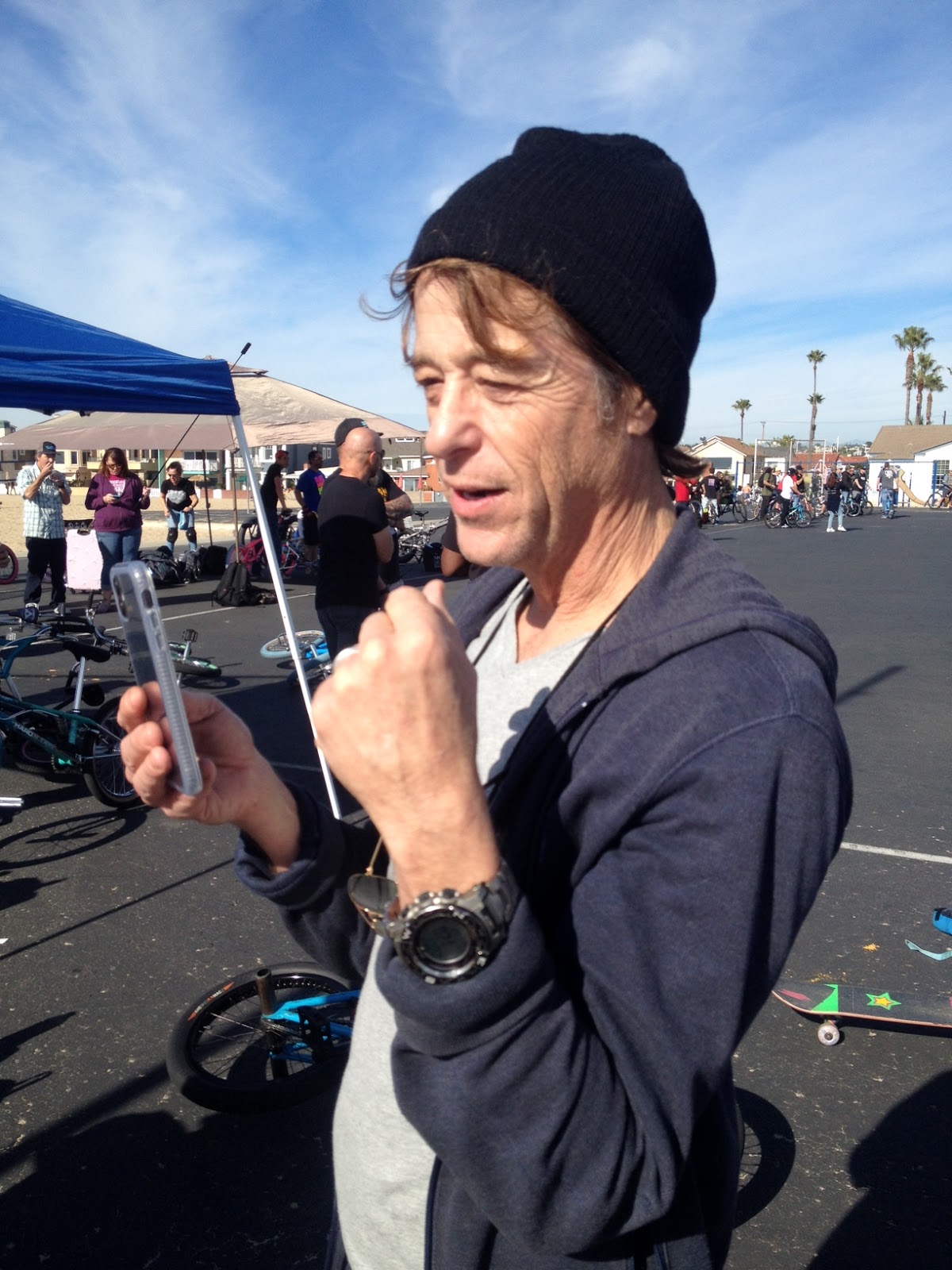
A kid. A BMX freestyle bike. And a parking lot. That's how freestyle started for so many of us across the U.S., U.K., and other parts of the world, in the 1980's.
The crazy series of events that led me to wind up staying within walking distance of this year's One Love Jam in Newport Beach kind of blows my mind. But the Universe is weird like that some times. From 1982, to 2003, I spent a couple hours or more, every day, on a BMX bike, learning tricks or street riding. The exception in that period was late 1999 and early 2000, the beginning of my taxi driving career. I stopped riding in 2003, when driving a taxi driving became a 7 days a week thing, and left no time for anything else. For me, BMX began in Boise, Idaho, in a trailer park, in 1982, sitting almost exactly at 43 degrees of latitude. Really. Before the whole 43 thing happened.
We had BMX magazines for inspiration. A lot of the early riders from outside Southern California were inspired by seeing the BMX Action Trick Team, or the Haro ot GT factory teams do a show. We didn't have Pipeline Skatepark or Del Mar. But we had parking lots. We all had a parking lot somewhere. So those early magazine trick how-to's from Bob Haro, R.L. Osborn, Martin Aparijo and Woody Itson, and a few others, gave us a starting point. The AFA Masters constests gave us a justification, a reason. We needed that, because in 1984, or there-abouts, you couldn't tell your friends and parents, "I'm spending three hours a day learning tricks on a BMX bike, just because it's really fun." But we could say, "I'm practicing for a national contest," people could understand that.
At the early AFA contests at the Velodrome, in Carson, California, this weird morning ritual would take place. A few of us would get there long before the contest, and we'd walk into the Velodrome, and sit on the first few bleachers. There would end up being 15 or 20 people, from all over, just looking forward to the days events. And we'd see someone we hadn't seen in a few months, and ask, "You still riding?" Because it kind of surprised all of us that we were still doing tricks on "little kids' bikes" then. There was always a couple guys who said, "I got a car, and stopped riding a month ago," or "I got a new girlfriend, and haven't ridden in a couple months," but I wanted to come see the new tricks." The rest of us would say, "Yeah, I'm still riding." It kind of surprised us. None of us really believed then that we'd be riding for more than a year or two. There was this feeling of, "OK, let's do this freestyle thing for a year or so," then we'll all go back to college, get some job we don't like, and do "adult life."
But BMX freestyle started growing. The Californian guys were super entrepreneurial, and little businesses began to pop up to make frames or components, or something else needed. Bob Haro came out with a freestyle bike. Bob Morales started putting on contests. R.L. and Mike Buff toured doing trick shows, as did the Haro and GT guys. Nearly all of us had local trick teams in our town. Some of us produced zines. Some started shooting photos. A couple years later, some people started producing our own videos. For a few of us, actual jobs in the industry came along. For the rest, freestyle never stopped being fun. It just kept going. And going.
Being a dork among the dorks, I spent more time thinking about the future than most of us early riders. But I never imagined a day when BMX freestyle would be in the Olympics (like it or not), or a day when 100 or more riders, ages 40 to about 55, would show up next to the ocean and session all day. There were a handful of the SoCal riders who got us other guys across the country stoked on freestyle in the early 80's. We all, collectively, rode the first big wave of popularity in the late 80's, and a new crew came up in the 90's. We didn't know what the fuck we were doing, we just knew it needed to be done. We had ideas, tricks needed to be invented, and that meant time in the parking lot day after day.
As things progressed, we needed better bike parts. We needed better frames. We needed better places to ride. We absorbed the punk rock/D.I.Y ethos (thanks Dave Vanderspek and the Curb Dogs), and just began to start doing the things that needed to be done to keep progressing. When the bicycle industry at large said, "BMX is dead, mountain bikes are the new thing," in early 1989, we saw the money drain from the BMX world and leave us in the lurch. That sucked at first. We had to get real jobs and learn to cook ramen. But it also freed us, nobody gave shit about BMX freestyle except the most hardcore riders at that point. So we just took it over. The progression on the bikes progressed at hyper speed, and riders took over the industry. It was a lifestyle to so many of us at that point, and we forged ahead, each in our own directions, and built an industry.
BMX splintered into flatland, ramps, dirt, street, and park riding. By that time we all had some models for doing our own thing, and making things happen. We had other people to look up to. Collectively, we built a group of sports, and culture and industries to support those sports. That's pretty fucking cool when you stop and think about it. It wasn't a 35 year plan. Bob Haro didn't sit down in 1981 and say, "OK, here's the 40 year plan to take BMX freestyle worldwide." It happened organically, bit by bit, day by day, session by session.
Ultimately, we set the stage for guys in tight jeans, who hate brake,s to make $50,000 for winning a single contest, by doing a quad tailwhip double backflip to fakie over jumps the size of a small mountain range. Yeah, not what we had in mind, but the riding has progressed far beyond most of us now. But all of us who rode back in the day, played a roll in making that happen, some to big degrees, most of us to much smaller degrees.
Now, 35 years after those first AFA flatland and ramps contests, we are still leading in a way. We're showing the younger generations how long it can go on. OK, not me, I got sidetracked for years. But the group of the riders at the One Love Jam yesterday is still pushing boundaries. They're showing younger people, a few in person, and many more in videos and various posts, like this one, that BMX freestyle is a lifestyle. None of us knows how long you can keep doing it, because we're the group that is figuring that out. The oldest of us is about 55, and we're not there yet. A bunch of guys are still riding hard in their 50's. Many in their 40's. Where does freestyle end? 65? 70? 103? We don't know, but we'll let you know when we get there.
The One Love Jam was an epic day. I had no bike, but Kid Fruhmann let me borrow one of the Fiola Former Pro bikes (like the ProFormer, but dsylexic), which rode great, I must say. I managed a lame infinity roll right off the bat, and three other tricks over the course of a couple hours. Lame as it was, I got my nearly 300 pounds and a bike to bunnyhop. Barely. It's been a LONG time since that happened. I scraped my calf, got a little blood to the surface, and called it a session.
I also spent time talking to Martin Aparijo, Ron Camero, Gardo and their crew (thanks for the spaghetti and egg rolls), Bill Nitschke, Rick Coronado, Dave Nourie, Ruben Castillo, Todd Lyons, Dave Voelker, Brian Blyther, Edgar Plascencia, Ivan from New York, James who I just met, and several more guys. It was an epic day all around. Thanks to the promoters, I don't even know your names, but it's was a great jam. The weather was perfect. Much stoke was manufactured and consumed. I can't wait until next year's jam.
Here's Sean Ewing's drone footage of the event, and links to a couple other early edits. Check Facebook and Insta for more.
Straight outta Indiana, lifelong rider, man who invented the Whopper (the bunnyhop tailwhip, not the burger), and still doing shows and showing people how much fun BMX freestyle is, Bill Nitschke.
Pete Brandt is a freakin' beast. He's in the midst of a hyperfast pedaling spin here. He was just riding at an insane level, all day long. If the Pacific Ocean was fresh water, he probably drank half of it, just to stay hydrated.
Another rider I don't know the name of, 90's era combo that's freakin' impossible.
Pete Brandt again, forwards rolling circle, no hands, bars spinning, physical laws of the universe temporarily suspended. This is not possible.
Guys. bikes. Asphalt. Ride some. Talk some. Ride some more. Somehow it turned into a lifestyle.
Looking down the groups of people on the periphery of the riding area. I didn't think there were this many old school flatlanders left in the world, let alone so many who are still riding at a really serious level.
Vert legends hanging at the flatland jam. Brian Blyther and Dave Voelker. Dave's got a big ride in San Diego coming up on the 25th, check his Facebook for info.
The Chairman at a board meeting. Martin Aparijo, drinking a coffee to make his Pepsi jealous. Don't tell anyone, but Martin's actually a really cool guy, helping all kinds of people step up their game in and out of riding. He also has a million great stories of the days before most of us started riding. If you ever get the chance, ask him some old school question and just sit back and listen.
San Diego flatland legend, big influence to most of us guys, longtime touring pro at Haro, Dave Nourie. He's still ripping it up and laving fun with it all.
Nourie, doing his thing.
Close-up, mid trick. Dave Nourie again.
Cru Jones was in the house. Some of the guys at One Love Jam were riding hard when the movie Rad was released in 1986. But many of the young bucks, you know, those guys in their 40's now, got into BMX because of the movie Rad. Here's a little clip of Bill from 2014, talking about how he ended up starring in Rad, and his life since.
One of my most popular blog posts ever was "Why I hated the movie Rad when it came out." I had nothing against Bill, Eddie Fiola, Martin Aparijo, and the riders, I just hated that the plot was so goofy, for the vert first American movie to have BMX freestyle in it. I was so invested in freestyle in 1986, and such an uptight dork in general, that when I saw Rad in the theater, I was just completely bummed. Except for the credits, that was "real riding" in my book. I actually liked Quicksilver, the bicycle messenger movie, a lot better. The jam session in Quicksilver was actually a lot closer to an actual BMX session, just on different bikes. And it had Martin and Woody in it. In the early 90's, when I heard the Sheep Hills guys talking about how much they liked Rad, like Sean Butler, I began to realize how many people wound up getting interested in BMX because of Rad's popularity on home video.
I liked BMX Bandits a lot, too, which was on HBO all the time in 1987. That movie had that cute redhead, Nicole something... Whatever happened to her?
Someone washed Regis in hot water, then threw him in the dryer and shrunk him. Wait, that's a 24 inch Haro with a bashguard he's on, that's why he looks so small. When Rome, do as the Romans do, when in Newport, surf at the beach. Regis G. blending in the locals.
We're old now. Remember back in the 70's when "Look ma, no hands" was a thing? Just riding without hands was probably the first actual bike trick many of us learned. Or maybe a skid. As the early BMX freestylers, we collectively took no hands to many new levels. Another example of that progression here.
The other way to do a double decade, two guys, sychro single decades.
Ruben Castillo, no smoke, but I think there was a fire hydrant somewhere in this combo.
Austin R-Dog, Texas For Life, Ruben Castillo. I haven't seen Ruben in many years, wasn't sure he'd remember me. He totally did, "I see your art online," he said, right off the bat. Bash it if you want, but I'm stoked we have Facebook and the internet these days, to keep in touch with all our old friends at a distance. Internet connecting is good, but it was awesome to hang out, ride (a little), and just talk with so many people from the old school flatland world, in person. One Love Jam is a great thing. I also met Ivan, standing right behind Ruben, at HB Tuesdays this week, cool guy from New York.
Backpacker. Not the kind on the Pacific Crest Trail or the kind that's college age and travels Europe. The BMX flatland kind. I'm glad I was old when these tricks came along, this shit's way too hard.
Far away, but I'm pretty sure this is Martin Aparijo, coming out of a megaspin.
Backwards infinity roll variation, in a straight line. Back in the day, I used to do standard infinity rolls in a straight line, and call them definitive rolls. So is this a backwards definitive roll? I'll let you decide.
Spinning.
He was hauling ass into these things. After my flatland era, fast gliding something or other.
Bikes looks so different today. Some in classic 80's styles, with vintage graphics, but most unique to the riders. This was one of the coolest looking bikes, and the rider, name unknown to me, was ripping all day.
Top: Scurfer. Bar ride... BUT.. one foot on a grip and one foot on the crossbar. WTF? He stepped into it from a surfer, after doing a Scurfer. Skills.
That moment when you know its lost, but you try to save it anyhow.
Back in the day, we often broke into bad breakdancing after we bailed. This guy decided to dance a jig instead.
I didn't know there were this many old flatlanders left in the world, let alone so many who still rip. Half of the crowd around the school playground, on the sand in Newport Beach.
Seriously, though it wasn't an actual parking lot, this is one of the coolest spots for flatland I've ever seen. Bars and seat gut lever.
Dennis McCoy shralping in pro flatland in New York in 1986. At one of the velodrome contests that year, I thought Dennis, who had the freshest, new style in pro flatland at the time, should have beat Woody Itson, the veteran icon of the day. I wrote that in my zine. It was my honest opinion at the time. Dennis, of course, was stoked when he saw the zine, and Woody was a bit bummed. Both of them rode great at that contest, and, like always, it came down to a subjective call by the five judges. Were Woody's well known tricks, executed flawlessly, better than McCoy's new style and flair and energy? No matter what the call, someone always gets pissed off.
When I got into BMX racing in 1982, it was usually easy to see who won. It was a race, after all, first guy (or girl) across the line was the winner. But even at the local BMX track there were issues. It had become a custom to stop pedaling about 30 feet before the finish line, and coast over the last little set of doubles and the finish line just beyond. No one even tried to actually race the last 30 feet. It was kind of like a gentleman's agreement, your place coming out of the third turn at the Fort Boise track was your place in the race, forget racing the last straight. I think it was much the same at other tracks, and at the national level, as well.
Us kids from Blue Valley trailer park, brand new to BMX racing, hungry to win a trophy in anything, decided to pedal to the finish, and pass the points chasers who were coasting. Then people got mad when we said, "Hey, I beat those two guys who were coasting." So even in the black and white world of a race with a distinct finish line, there were sometimes issues. For a couple of races, we made the lazy kids pedal those last 30 feet. Other riders gave us crap, then we eventually stopped pedaling at the end, and we too, and joined the program.
But when BMX freestyle came along, and it was a brand new sport in 1984, we all soon learned the problems of subjective judging. Subjective judging is simply anytime that a group of judges judge an event, score the contestants based on their person opinion of the performance, and the winner is the person with the highest total score. There's no absolute winner by objective facts, like being the first over the finish line. With subjective judging, you have a few personal opinions that find the winner. And personal opinions can be affected in a whole bunch of ways, as we all soon learned.
This was one of the reasons that pro freestyler R.L. Osborn, and a few others, at first, didn't like the idea of even having BMX freestyle competitions. It's hard to believe now, but for maybe a year, that was actually an issue. Up until then, flatland and quarterpipe riding had been a demonstration sport. Riders performed in shows, and people clapped and cheered, or they didn't. But eventually competitions were accepted as a necessary, if kind of annoying, part of freestyle.
Since a flatland or ramp routine was a performance, like music or dance or figure skating in that respect, that meant a group of people had to judge the performance, and score each contestant against the others, and the high overall score would win. This opened up several cans of worms, and suddenly half of the riders, or more, were mad at the judges at the end of the day at every contest. Ultimately, over the course of those first 3 or 4 big years of AFA contests, we all learned the basic truth of subjective judging.
Subjective judging sucks. Sometimes it works in your favor. Sometimes it works against you. Deal with it!
One of the first issues was, who do we get to judge? Since BMX freestyle was a new sport, there were no old pros, who had ridden for years, to judge. So industry guys, usually former BMX racers, originally judged freestyle pros, and the current freestyle pros were tapped to judge the amateurs. This didn't work too well, though it seemed to make sense at the time.
It turned out that veteran racers, while great BMX riders, didn't know the nuances of the ever evolving world of freestyle tricks. Having never done most of the tricks, they just didn't know which tricks looked hard, and which tricks were hard. At the same time, when the sport was so new, there might be 40 different riders, at every contest, doing tricks that were completely new. Those were tricks that no one had seen before, outside of that rider's group of friends. So no one knew if the tricks were actually hard. Some easy tricks look great, like Dennis McCoy's fancy footwork back then. It looked amazing, but wasn't really hard at all. I'm not dissing Dennis, he did plenty of really hard moves, but the footwork that blew people's minds at first, was flashy, but technically not that difficult.
Another issue was that pro freestylers made lousy judges, by and large. Judging a freestyle contest (or any event with lots of participants), takes concentration, among other things. We soon found that the last thing pro riders wanted to do at a big competition was to watch dozens of younger, mediocre riders, and try to place their routines in the precise order of who was better than who. Pros wanted to hang out, talk to old friends, meet girls, and have fun. They didn't want to watch goofy kids from Idaho balance on their bike and juggle tennis balls. That was what I did my first contest, by the away. Nothing blows your concentration like starting your first routine at a major contest and having the announcer say, "And here's Steve Emig, from Boise, Idaho, with his balls in his hands."
In time, and especially as competitions grew, and the AFA had to deal with huge groups of 50 or more riders in a single class, we learned that parents of riders made the best judges. The parents were less distracted, they were older, more mature (usually) and they were much better at concentrating and trying to fairly judge a large group of riders, many of whom were very close in talent level. From a purely functional level, the parents that volunteered at contests made good judges.
Having parents judge the large amateur classes, of course, led to the most obvious problem with judging, bias towards, or against, certain riders. If a parent was judging their own kid in a contest, everyone expected them to judge their kid above the other riders. That did happen on occasion, and the AFA tried to get other judges to fill in for the classes when a judge's kid was riding. With a limited number of parents to judge, and lots of riders, that wasn't always possible.
There were other issues with parent's judging. As hard as it is to believe, sometimes a rider's parent would judge their own kid harder, just to make sure that everyone thought they were being fair. Then the kid actually placed lower. It didn't happen often, but it actually did happen. Another issue with parents judging contests is that they don't know all the tricks, especially the new ones, which leads to new tricks getting judged at lower scores than older, better known tricks. Another issue with parents judging was that the tricks they were most familiar with were the tricks their kids did, or were working on. So if Timmy was good at boomerangs and decades, but never did tailwhips, then boomerangs and decades got judged higher, usually without the parent doing it intentionally. Another weird aspect of parents judging their kids is that sometimes they would judge their own kid on how good they usually did the trick, not how they actually performed it in the contest. At times, and again this was largely unintentional, a parent would watch their kid ride and think, "Bill dabbed his foot on that decade, but usually he can pull it every time," so they wouldn't count it against them.
All of those things were issues we had with parents judging at those AFA local and AFA Masters contests in the mid to late 1980's. While their were issues, mostly the parents did a better job judging than anyone else would have. I know. I worked for the AFA in 1987, and I got stuck judging a few classes at the big Masters comps. Seriously, watching 50 kids, especially like 14-15 novice or intermediate flatland, just plain sucked. I tried to be fair, like all the judges, but most of the kids were boring as fuck to watch, and it was easy to get distracted for a few seconds, and miss that one good trick they did. Then, trying to get the 30 middle riders in a reasonably correct order, though they all were pretty much the same, was pretty much impossible. To make it even worse, we judged knowing at least 5 or 10 kids would be bitching at us the rest of the weekend because they got 27th in 14-15 intermediate, and they thought they were better than the kid who got 14th. We just wanted to scream sometimes, "Go practice more so you'll stand out, kid!"
Another issue was just the dynamics of actually judging. What score do you give the first kid? If he's awesome, do you give him a 98? What if three more guys are better later on? We soon took to giving the very first rider a 75, which gave us room to judge both up and down from there. If the first kid was really good, then most of the riders would score below 75. If the kid sucked, most of the other riders would score above 75. Then kids in one class would say to their friends, "Hey, I got an 82 and you got a 72 in your class, so I'm better than you. But the scores didn't transfer from class to class. Also, the riders that rode last pretty much always scored better. It just always worked out that way, even though we tried to score fairly. But it was impossible to explain that to kids. So those were some of the issues we dealt with for the masses of riders in the amateur classes. No matter what, some kids were always mad, that's just the nature of subjective judging. The top few riders always stood out, but even getting them in the correct order was still hard.
Judging the pro classes was a different story, for several reasons. First of all, there was money on the line. OK, it was the AFA in the late 80's, the first wave of BMX freestyle popularity, and there wasn't much money. But a little change in judging could mean a couple of places, and several hundred dollars more or less in prize money. Another thing was that the pros, mostly, were all pretty close in riding skills (Fred Blood excepted, of course ; ) ), and so the judging was always tighter. Then there were titles on the line, winning the contest looked a lot better to the rider's sponsors than getting third. The pros also did harder tricks, and had different styles, so the judges were often judging one rider's style against another. That was the issue at the Velodrome contest where Woody Itson beat newcomer Dennis McCoy, but I thought Dennis should have won. Was Dennis' style and showmanship really better than Woody's classic, known to be hard, tricks. Flip a coin, on any given day it could go either way. Because the class had far fewer people, we often had either pro flatlanders judge the ramp riders, and vice versa, or top amateurs judge the pros. That worked pretty well. It's much easier to pay close attention to 8 pro riders than to 50 novices.
Then we finally get to the issue most people think about with subjective judging, personal bias. Did that amateur rider from Hutch score Mike Dominguez higher than Eddie Fiola because Mike rode for Hutch? Did someone pay a certain judge to throw the contest? Did someone score a pro higher because they were a fan of that pro years earlier, when they were just getting into riding? Did a rider get scored higher because their style was just the trendy style at the time, and there were, and still are always trendy styles. Did the technical rider doing harder tricks score higher than the rider doing less hard tricks, but with more style? That was the classic issue in skateboarding at the time, with Tony Hawk's tech tricks versus Christian Hosoi's high air and style. Did a certain rider have an off day, but still score high just because of their name recognition? All of these things happened at some level. Overall, most of the judges, most of the time, tried to do the best job they could. But there were problems.
And that's my whole point with subjective judging. IT'S NEVER FAIR. Period. Sometimes you get screwed as a competitor. Sometimes things worked in your favor. Over the long run, the best riders score well on a consistent basis. But it's never fair, whether it's a local contest with five kids, or it's figure skating in the Olympics. And the more that is at stake, the harder it is to judge accurately, the more likely it is to be contested, and the more pissed off someone will be.
This is my big problem with BMX freestyle and skateboarding being in the Olympics. Those huge, once every 4 years, contests are about "crowning champions." Those champions are then used in all kinds of money making and sponsorship ventures and commercials. The drive to rig the system is incredibly high, because there can literally be millions of dollars at stake. And as freestylers, and I was a hardcore, if not great freestyler, for 20 years, we know that one placing at one contest really doesn't mean all that much. It's nice. But it doesn't make you the "best rider ever." It doesn't make you the most progressive rider, or the most influential rider. Winning one contest, ANY CONTEST, doesn't make you THE CHAMPION. That's kind of the whole point of action sports. Lots of different styles, lots of different riders, and no one's really the best ever, until you get to a long term innovator like a Mat Hoffman or Kevin Jones.
Winning at any major contest means that a certain group of judges, who may or may not have tried to do a legit job, who all had their personal biases, judged you to be the best, on that day, in that location, at that time. You won the day. Maybe you deserved it, maybe you didn't. And that's just the way it goes with subjective judging. Again, it's never completely fair. So should you make $3 million for getting on the Wheaties box and in the TV commercials, and the rider who came in second on that day be completely forgotten? Most of us who've put time into learning an action sport at some point say, "No." But that's how it goes with the Olympics, or even the X-Games.
One more thought. Subjective judging seriously stifles creativity and innovation. Ever see a figure skater do a SWITCH triple Lutz? No. Never. You haven't. Do you know why? Because there is no pre-figured out score for doing anything switch, or opposite direction, in figure skating. Yes, it would be much harder, but they don't do it, because they wouldn't get scored for it if they did.
Figure skating has been a competitive, subjectively judged sport for at least 160 years. The origins of the sport go back to at least 1772. But no one does the high level tricks in the opposite direction in the Olympics. In skateboarding and BMX freestyle, people started doing switch tricks in the late 1980's, only a few years into BMX freestyle or street skating competitions. In a few years those sports evolved more than figure skating did in 160 years. Why? Because riders and skaters progress naturally, organically, and without certain number scores being given to particular tricks. The creativity in figure skating (or gymnastics, or any older judged sport), has been dramatically reduced to turn it into a sport. The same is true of BMX vert, park, and street today. Imagine a top rider in a comp today doing a major contest routine WITHOUT a single flip, barspin, or tailwhip. Boom, they're not even in contention for a top placing, no matter what they do. Does that mean the riders who don't do those tricks are worse riders? Think of a run by Brian Foster, Chris Doyle, or Gary Young. Oh, those guys are/were as good as the top contest riders, and they can blow your mind in a contest setting, without the "standard" tricks. But they're not going to win a contest in nearly any case, because they don't do the current trendy tricks like 25 barspins, tailwhips, and flip tricks.
I'm not against contests in actions sports, they provide a good reason to push harder, to progress in some areas of riding (but not necessarily creativity except for best trick comps), and to travel different places, which gives riders and excuse to ride with new people. But it would be really cool to simply acknowledge BMX freestyle (or flatland, park, street, vert, whatever) contests, with subjective judging, for what they do. They tell you that on this day, in this place, this group of judges thought this person was the best. That doesn't make that person the best ever, it makes them a really good rider who won that day.
I know that's a lot to ask. But a few of us got into a big Facebook discussion on this the other day, starting with the question of whether BMX freestyle (park, street, and maybe vert) should be in the Olympics. I say they should not be in the Olympics. Anyhow, that online discussion gave me the idea to write down some of my ideas about subjective judging, and it's role in action sports, and other sports, in today's world. If you have comments, let them fly in the Facebook groups, or wherever. I'll read them, and reply when needed.
I just started a new blog for Marvin Davits, to promote Marvin's business, installing dinghy davits on boats and yachts. Check it out.
Somewhere in the last couple years, I met Scotty Zabielski on Facebook. When I couldn't find a "real job" here in NC, I decided to focus on turning my writing and art into a small business. Scotty Z ordered a drawing, then another, then a few more, then even more. Doing drawings for him was huge help in me progressing in my art, and getting the art thing heading towards a business. Thanks Scotty!
In this clip, OFG (Old Fat Guy) BMX interviews Scotty at a flatland jam he organized near his home in Indiana. The highlight is Scotty getting shaved and then having his chest waxed to raise money for St. Baldrick's ti help childhood cancer. Near the end of the clip, he gives me a shout out for doing a bunch of drawings. Thanks Scotty, I'm hoping to make it up there for one of these old school BMX events one of these days.
Here are some of the drawings now hanging on walls in Scotty's beach house:
I could spend all day agonizing over what video to put here. There are dozens of great riders who left their mark on the early days when freestyle was spreading across the world from SoCal. But one of the riders we all were stoked to watch was NorCal ramp man Hugo Gonzales. Before the term "Huck it" became popular, Hugo was keeping us all on the edge of our seats. We never knew what he was going to try. I'm pretty sure he didn't even know sometimes.
To nominate a rider for this list, I need three separate riders from the era to nominate them. This isn't a formal thing. I just kept hearing chatter on Facebook about what rider was going make this year's "official" Hall of Fame. Like so many ideas in years past, I thought, this is a DIY sport, why doesn't somebody do a their own freestyle Hall of Fame? And nobody did. So here it is. Start droppin' names and lets see what happens. People can be in as many categories as they legitimately fit.
BMX Freestyle Pioneers Bob Haro- The whole thing was his idea 1970's Jumping Pioneers Scot Breithaupt- The Godfather of BMX- (SE, Jumping "Trash Can" Morgan- (SE, Chris Moeller- (SE,
Flatland R.L. Osborn- (SE, Woody Itson- (SE, Martin Aparijo- (SE,
Old School Skateparks Eddie Fiola- (SE, Mike Dominguez- (SE, Brian Blyther- (SE, Jeff Watson- (Bill Bunting,
Wedge Ramps John Dizz Hicks- (SE, Mike Buff- (Mike Garrity,
Quarterpipes Ron Wilkerson- (SE, Mat Hoffman- (SE, Hugo Gonzales- (Jason Goldsmith, Brian Reed)
Halfpipe
Street Dave Vanderspek- (SE, Eddie Roman- (SE,
Overall Riders- Dennis McCoy- (SE,
Dave Voelker- (SE,
Photographers Bob Osborn- (SE, John Ker- (SE, Windy Osborn- (SE,
Video producers/editors Don Hoffman- (SE,
Eddie Roman- (SE, Mark Eaton- (SE,
Industry Pioneers Scot Breithaupt- (SE, Bob Haro- (SE,
Rider/Entrepreneurs Chris Moeller- (SE, OK, These first few names are my nominees to get the ball rolling. The first three people that nominate each rider will get their names in parentheses after the nominee. I could EASILY add 100 names to this list myself. But I want all old school riders to get their voices heard, unlike that other HOF. Remember, this is where it all started:
When I thought of great, all-around riders from the 1990's, my old P.O.W. House roommate Brian Foster was the second one who came to mind. He's got pro racer speed, gets huge air, rides all kinds of terrain, and has one of the classic styles of all time. The first guy to pop in my mind was Ryan Nyquist, but I know he'll be on the list below on no time flat. Yes, I know Brian was riding in the 80's, and this clip is from a few years ago. But he really made a name for himself in the 90's.
To add a name to this list, I need three separate riders from the era to nominate that person. You can submit names to me on Facebook (Steve Emig-Winston-Salem, NC) or email them to stevenemig13@gmail.com . I expect to be overwhelmed, so be patient, it may take a while for your nominee to get put on the list.
Never met him, but Morgan Wade has been one of my favorite riders to watch in the 2000's. To add a worthy rider to the list, I need three separate riders to endorse that name. You can contact me (Steve Emig- Winston-Salem, NC) on Facebook or email me at stevenemig13@gmail.com . It may take a while to get your guys on the list, have patience.